
A cultivated instinct that changed how the world moved
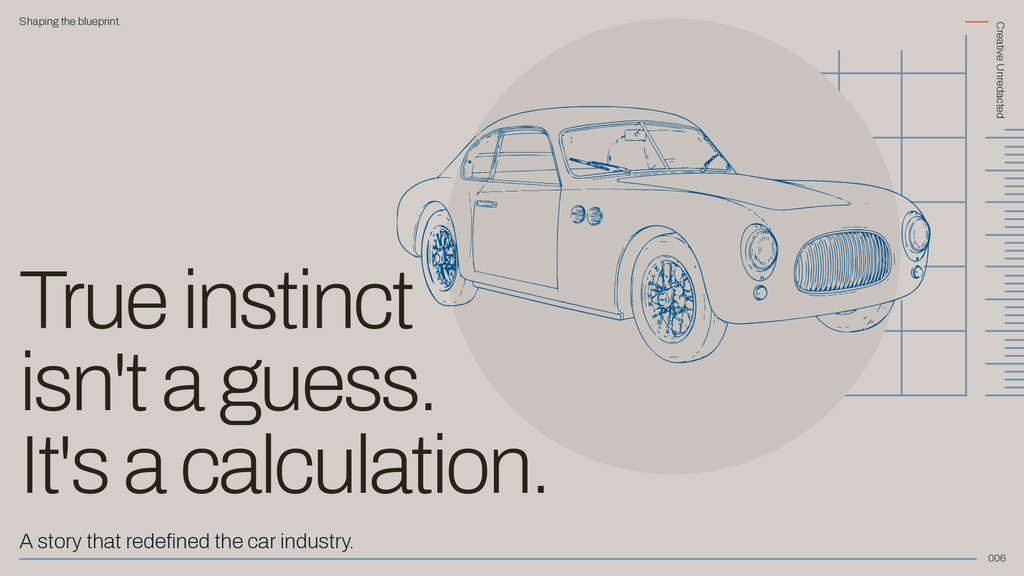
Before 1947, cars were designed in pieces. A cabin box, bolted-on fenders, running boards, and exposed headlights. Then, Battista “Pinin” Farina came along to help shape the Cisitalia 202.
He did something radical. He pulled the hood down, raised the fenders, and embedded the headlights directly into the car’s body. The entire vehicle became a single, continuous, flowing line. It looked like a smooth stone carved by a fast river.
Despite Cisitalia’s financial failure, the 202 changed the industry forever. Today, every car company designs cars with Pinin Farina’s design psychology. And the Cisitalia 202? It seats at the Museum of Modern Art in New York with the description “sculpture in motion.”
The three-second instinct
Breakthroughs like the 202 don’t come from a spec sheet. They come down to the instinct of a person who instantly knows if what’s in front of them has the gravity to change things. It is easy to look at that split-second judgment and think it’s just a reckless, ego-driven whim.
But true intuition is a calculation.
For Farina, that instinct was forged early in his career, working directly with raw sheet metal on the manufacturing floor.
So when it came to designing the 202 his gut was just processing a career’s worth of experience at lightning speed. The three-second magician is built by experience and maintained through real world exposure.
Connected to a bigger story
People with this kind of instinct are always plugged into a larger human frequency. When they look at something, they are instantly checking whether it connects to where the world wants to go next.
In 1947, a post-war culture was quietly desperate for rebirth. Farina’s gut didn’t just reject the old look of a car; it rejected the disjointed, heavy energy of the past. The seamless style of the Cisitalia 202 was the exact physical form the world was waiting for.
But the story doesn’t end there.
What happens when the connection breaks?
When the connection breaks, you stop gathering data, listening to the market, and looking at the friction of the real world.
Maintaining this capacity is where most creators and brands fail.
For over sixty years—even long after Battista passed—the legendary design house he founded served as Ferrari’s creative soulmate, shaping its most iconic vehicles. That partnership eventually came to an end in 2012–2013, but Ferrari kept its connection grounded.
Forward to 2026: enter the Luce. Ferrari’s first-ever fully electric car.
Ferrari bypassed its traditional automotive roots and brought in the former iPhone designer, Jony Ive, to shape the car. The car was ruthlessly mocked at its launch.
What went wrong? They isolated themselves from the frequency of the culture they were building for: car enthusiasts.
Real impact doesn’t happen because of a famous name or a clever marketing trick. It happens because you connect with a problem deep in your heart, listen to the world, and build the exact thing the world needs next.
Farina understood this throughout his entire life. He stayed fiercely connected to the emotional frequency of car culture, creating legendary masterpieces up until his final days because he never stopped listening.
Are you listening to the world?