
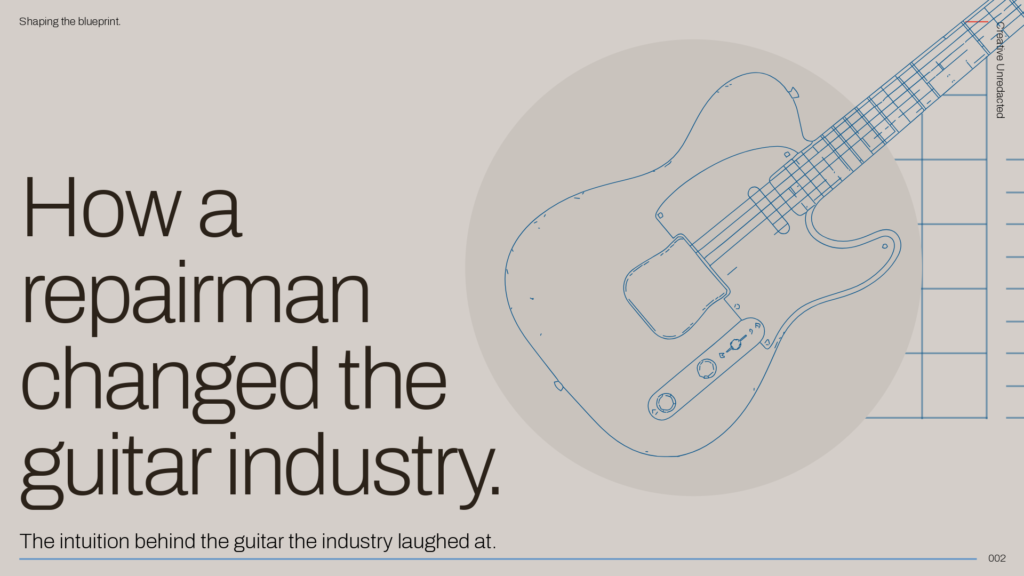
How a repairman changed an industry
In 1950, the established guitar brands made instruments that were hand-carved, expensive, and treated like museum-grade art. Then Leo Fender showed up with a flat piece of ash wood and a maple neck bolted onto the body with four screws. He created the first mass-produced solid-body electric guitar.
The competition called it a “snow shovel” and a “boat paddle,” but they didn’t realize he was rewriting the entire industry.
Within a few years, the Fender Telecaster completely took over the market, fueled the birth of rock and roll, and left the old brands scrambling to catch up.
The Logic of the Repairman
Leo Fender’s day-to-day was built around fixing broken gear so people could get back to doing what they loved. Because his background was in repair rather than performance, he approached the guitar without any romantic biases.
If a traditional, glued-in guitar neck warped on tour, the instrument was dead for months. Leo’s design choices were pure utility: you unscrewed the four bolts, threw the ruined neck in the trash, slapped a new one on, and played the gig that night.
That obsession with utility dictated everything. When a lawsuit forced Fender to stop using the guitar’s original name (The Broadcaster), Leo didn’t freeze production. He walked onto the factory floor with a pair of scissors, snipped the name off the logo decals, and shipped the guitars blank. He knew the players didn’t care about a trademark—they cared about the tool that let them connect with a crowded room.
The Legacy Trap
There is a bitter irony to where Fender sits today. They are now the old corporate guard. They stopped asking the one question that made them a legend: How are we enabling people to do what they love?
In 1950, it meant a bolt-on neck and a solid slab of wood. But today, every electric guitar on earth is built that way.
Today, enablement means consistent production quality, service, community connection, and leveraging your position to create access.
Enablement is possible beyond a cheaper, mass-produced product. A brand like Fender will inevitably hold immense authority and gravitas, allowing them to have higher price tags because they created something timeless.
But to protect the deep emotional connection with your audience, you have to strip away the corporate armor and go back to what built the connection in the first place.
True legacy means understanding that your brand is never the main character. When you lose focus on how you are actively connecting with your audience, you miss the mark entirely.
In Fender’s case, you stop being the tool that democratized an industry, and start being a company that just sells expensive nostalgia.