
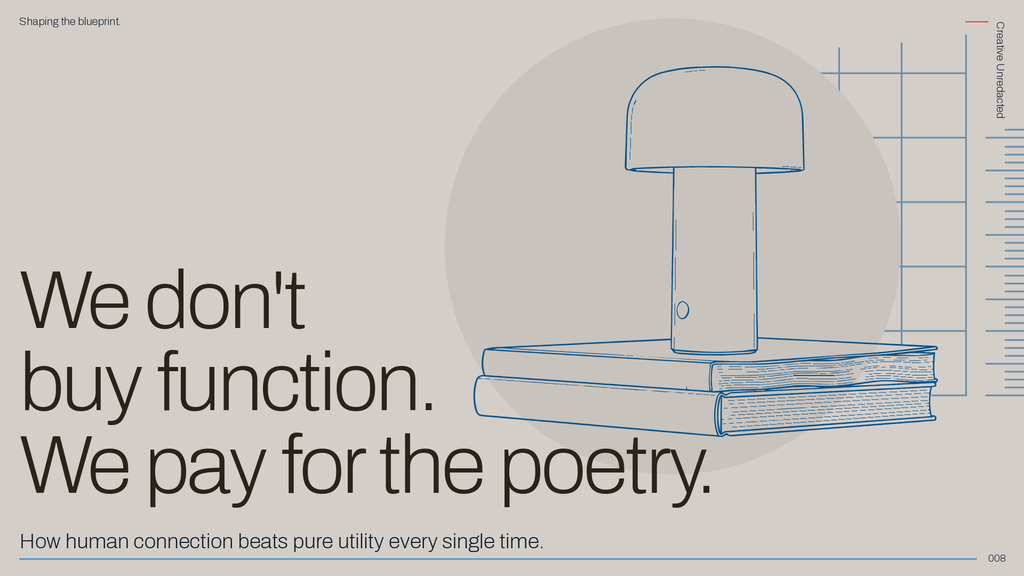
We pay for the poetry
My friend has a thing for cute candle holders. She buys a beautiful set, place them perfectly on a shelf, put brand-new candles in them, and then never light them.
To an analyst, an unlit candle is a broken product failing its core utility. But to a human, it’s doing its job perfectly just by existing.
We often evaluate things by what they do—the specs, the features, the efficiency. But human decisions don’t necessarily work like this.
The entire lighting industry is the living proof of this: a multi-billion-dollar market built entirely to sell covers for five-dollar lightbulbs.
We are paying for the poetry.
The Cordless Mushroom Lamp
Look at the massive explosion of cordless, rechargeable “mushroom” lamps over the last few years.
From a strict utility standpoint, they make absolutely no sense. The batteries die after a few hours, they aren’t nearly bright enough to illuminate a room, and you have to constantly plug them into a wall to charge them.
Yet, millions of people have willingly dropped hundreds of dollars on these tiny plastic and glass domes.
Why? Because they aren’t buying an appliance; they are buying a feeling.
The designers at Flos literally call it a “modern candle.” It creates a tiny, intimate, three-foot pool of soft warmth wherever you set it down. You carry it from the kitchen island to the coffee table, then to your bedside nightstand. It feels less like hardware and more like a glowing pet.
Most companies optimize the poetry out
Right now, companies are completely obsessed with optimization. They want to make the fastest app, the most streamlined-feature-heavy tool, or the most efficient service. Companies cut anything that doesn’t serve a strict, measurable function.
What businesses don’t realize is that true premium value lives in the irrational margin—the part of the object that serves no technical purpose, but simply connects us to life.
Leaning into poetry
The irrational human connection people make with a product or service will never show up on a feature list.
I chose clear+ at an airport just because how the brand showed up and the way people approached me gave me a sense of peace navigating through it. I have chosen to keep partnerships because the interactions lead to good ideation even when the executions were not flawless. Heck, even food tastes better depending on the experience you get from the staff.
We all connect at a deeper level than business transactions.
The next time you are shaping a brand or a product, stop only asking what it does. Start asking how it changes the room.