
You can’t clone the back room
It was 5:48 PM on a Friday, right after a massive project had finally been pushed out the door and a question just hit me:
“How do we even stand out anymore?”
Not even one good answer popped in my mind but the thought stayed with me. Now, this whole thing makes me think of late-night talk shows.
What about talk shows?
Think about the format. It is a total commodity that has been copy-pasted for decades. You have a monologue, a house band, a desk on the right, a couch on the left, and a fake city skyline in the background. On paper, every single one of these shows is identical. Yet, one becomes a legendary cultural phenomenon while another just doesn’t get the same pull.
Why? Because nobody tunes in for the desk. They tune in for the magic that happens behind the host.
The magic behind the host
The magic isn’t the template; it’s the human friction just out of frame.
A great show relies entirely on the energy of a writers’ room; distinct individuals throwing weird ideas at a wall and feeding off each other’s perspectives. That chemistry creates an uncopyable culture. You can buy the exact same furniture and build the same set, but you can’t clone the back room.
Look at David Letterman in 1982. NBC gave him the standard desk and couch, but his head writer, Merrill Markoe, ran a back room that refused to play it safe. She invented iconic bits like “Stupid Pet Tricks” and “Viewer Mail” taking a rigid format and injecting it with a human perspective that has redefined television for the last forty years.
Copy the format, not the vibe
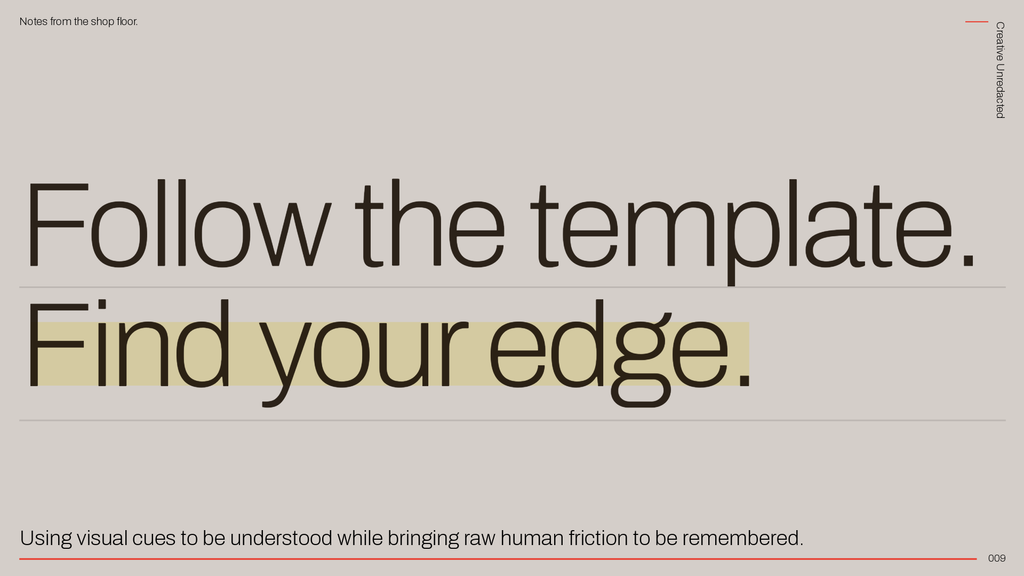
There is a reason talk shows have the same format, just like there is a reason industries use the same colors, typography styles and feel.
There are cultural and psychological cues that connect people to it. Light greens, blues, or soft pastel colors make people feel safe and at peace, a spa with bright red and hard edge typography in their brand will never make anyone feel relaxed. On the other hand, have you ever fallen in love with a pizzeria that doesn’t use some sort of red to yellow color hue?
Design cues help people understand what you do and help people connect with you instantly, but just like the talk show later tonight, you need the back room to differentiate.
What’s happening in your back room?
To make something land, collaboration is everything. Even the world’s best director needs a room that pushes back.
Real collaboration isn’t a status meeting or a task list. It’s distinct people bringing their raw perspectives into the room until something catches fire. That friction is the magic. It’s what creates the subtle, human signal your audience actually feels on the other end.
Standing out isn’t about inventing a brand-new format. It’s about building a back room with enough real chemistry to own the show.